
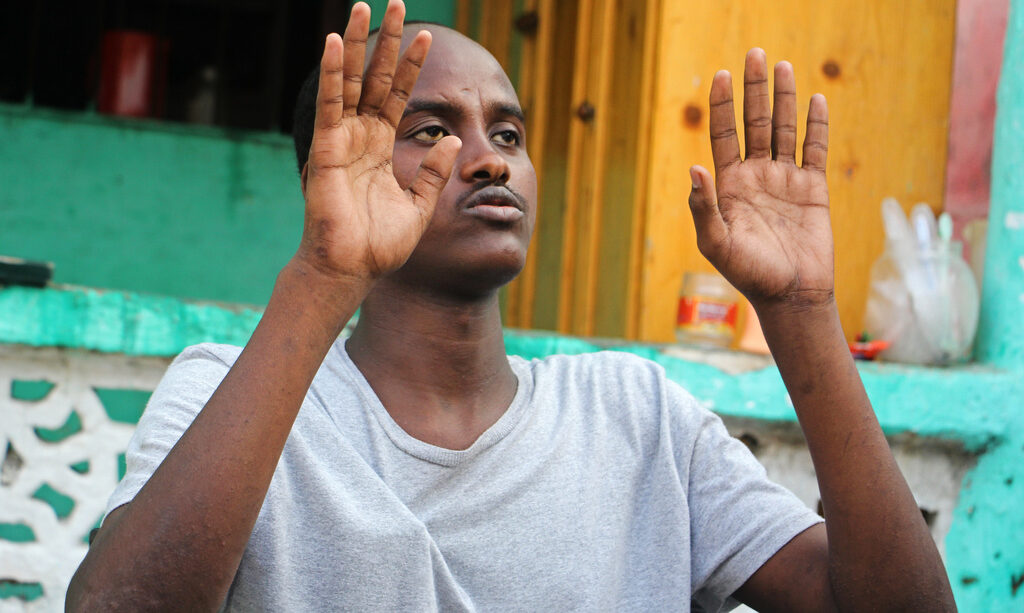
Mohamed Abdi Awale left Mogadishu, Somalia, in search of safety and opportunity, hoping to reach the West. His journey took him over 5,000 kilometers (3,100 miles) across Kenya, Uganda, South Sudan, and Sudan.
Near the Sudan-Libya border, he was captured by human smugglers and taken to Kufra, a remote desert town in the Sahara. There, he endured repeated torture as captors demanded a ransom from his family.
“Torture became normal,” Awale recalled. “If you failed to pay, they beat you until you fainted. Some people lost their minds. Others didn’t survive.”
Unable to afford the ransom, his mother, Hawo Elmo Rage, turned to social media for help. She raised $17,000 to secure his release. Afterward, Awale and a group of migrants traveled by car toward the Mediterranean coast, but when their vehicle broke down, they walked for more than two weeks across the desert, facing starvation and dehydration.
Awale’s story is not unique. According to the International Organization for Migration (IOM), migrants traveling through Libya face “unacceptable and inhumane conditions,” with reports of abuse, forced labor, and kidnapping for ransom common along the route. Libya has become a key transit point for migrants attempting to reach Europe, with tens of thousands stranded in detention centers and camps under dangerous conditions.
Detention, Repatriation, and the Somali Migration Crisis
After reaching Tripoli, Awale and the group were detained. He spent a month in prison in Sirte and another two months in Tripoli before being repatriated to Somalia in November.
Awale is part of a much larger migration crisis. Somalia has faced more than three decades of civil war, leading millions to flee. The UN refugee agency UNHCR estimates that more than 900,000 Somali refugees live in neighboring countries such as Kenya, Ethiopia, and Yemen, while another 3.5 million remain displaced within Somalia itself. Many seek safety and stability abroad, while others are drawn by the hope of better economic opportunities in Europe or North America.
The migration route through Libya is especially deadly. IOM data shows that thousands of migrants die or go missing in the central Mediterranean every year, with Libya serving as a hub for smuggling networks that exploit the vulnerability of migrants from Africa and beyond.
Dreams of a Better Life Amid Rising Barriers
For Awale, the dream of moving to the United States remains alive despite tightening restrictions. In June, the Trump administration banned travel from Somalia and 11 other countries, and the White House recently paused immigration applications from 19 nations, including Somalia.
“I felt like Trump closed that door,” Awale said. “Maybe after his term ends, I will try again.”
His mother wishes he could stay in Somalia, but she understands his longing for safety and opportunity. “I pray God gives him a safe future — not the dangerous one he found,” she said.
Awale’s journey reflects the broader challenges facing Somali migrants: navigating dangerous transit routes, surviving detentions, and confronting increasingly strict immigration policies abroad. Despite the risks, tens of thousands continue to pursue the hope of a better life, showing the resilience and determination of those forced to leave their homes by conflict, instability, and poverty.