
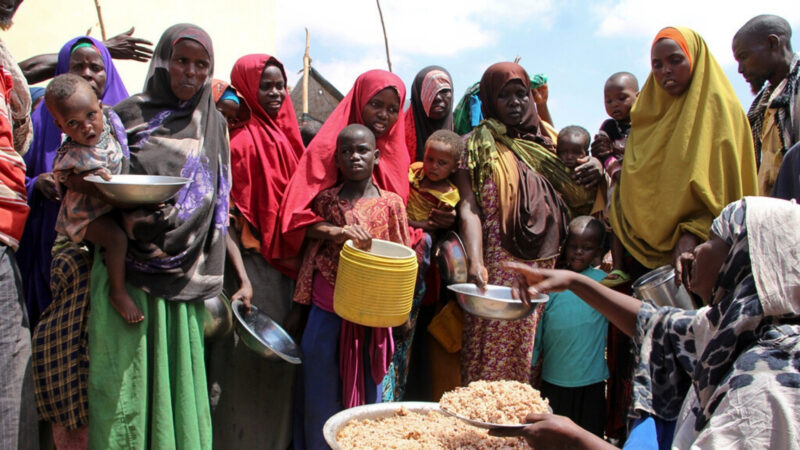
The World Food Programme (WFP) says hunger in parts of Cameroon could reach catastrophic levels if the agency does not secure at least $67 million in urgent funding.
Speaking in Yaoundé on Friday, Gianluca Ferrera, WFP’s representative for Cameroon and São Tomé and Príncipe, said progress made in recent years is now at serious risk.
He warned that many of the agency’s life-saving programs may be forced to stop without new financial support. “Without this funding, most of the activities that WFP and partners have been implementing will have to stop,” he said.
Multiple Crises Pushing Communities to the Brink
Cameroon is facing one of the world’s most neglected displacement crises, according to a Norwegian Refugee Council report released earlier this year.
The country is dealing with a mix of conflicts and climate shocks. Boko Haram continues to threaten communities in the Far North. The two English-speaking regions remain affected by a separatist conflict.
In the east, refugees continue to arrive from the Central African Republic. On top of that, extreme weather events have made life even harder for vulnerable families.
These overlapping crises have forced millions of people from their homes and made food insecurity a daily reality. WFP says more than 3.3 million people need humanitarian assistance, and over 2 million are internally displaced.
School Meals and Food Aid Under Threat
Ferrera said the funding shortage will have immediate consequences. More than 52,000 children could lose their daily school meals starting in January.
WFP may also have to close five offices in Cameroon, a move that would cut off food and nutrition support for more than 500,000 people. “So we may go backward instead of going forward,” he said.
Aid Levels Drop Sharply
WFP received $106 million in funding for its Cameroon operations in 2022. This year, the amount has dropped dramatically to only $20 million.
The shortfall comes amid a wider decline in U.S. foreign aid. Under the Trump administration, U.S. assistance fell to $64 billion in 2023, the last year with complete data.
Officials argued that agencies like USAID had achieved little since the Cold War. But a Lancet study published in July credited USAID programs with preventing 91 million deaths between 2000 and 2020.