
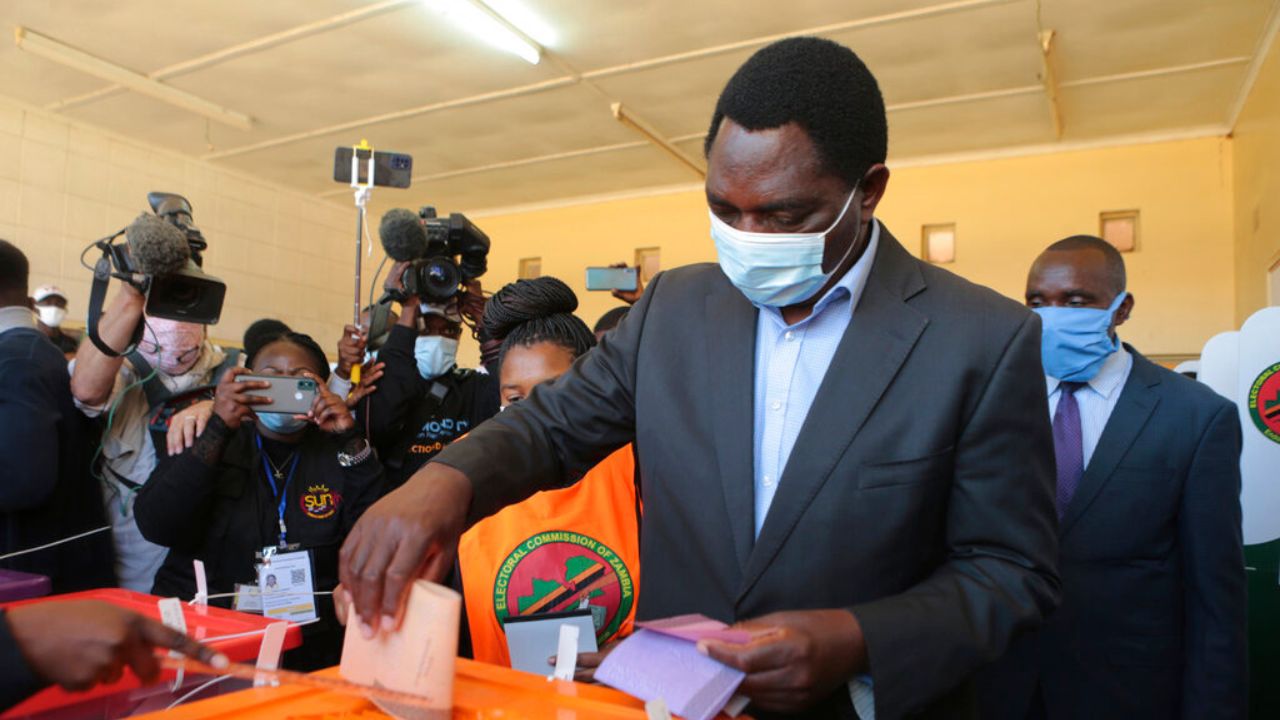
Zambia, once synonymous with sovereign debt crisis, votes Thursday in an election that will test whether President Hakainde Hichilema has convinced voters his economic reforms are working.
Hichilema is seeking a second term against a divided opposition field.
From Chinese investment to Victoria Falls, here’s what to know about the southern African nation of 22 million people.
1. Copper Is Zambia’s Economic Backbone
Zambia is Africa’s second-largest copper producer, trailing only the Democratic Republic of Congo, and ranks eighth globally, according to the US Geological Survey.
Copper generates roughly 70% of the country’s export earnings.
With global demand rising for copper used in electric vehicles, power grids and renewable energy, Zambia is positioning itself as a key supplier for the energy transition.
The government has set a target of tripling annual copper output to 3 million metric tonnes by 2031, a push that’s attracted major investors, including OpenAI CEO Sam Altman and Microsoft co-founder Bill Gates, who are backing KoBold Metals.
The company broke ground in May on a $2 billion project expected to become one of Zambia’s largest copper mines.
2. A Major Debt Turnaround
Zambia became Africa’s first sovereign default of the Covid era in 2020, following years of heavy borrowing and a collapse in commodity revenues.
The government has since secured a landmark debt restructuring deal with official and private creditors, unlocking an IMF bailout and easing pressure on public finances.
According to a government debt sustainability analysis published in March, Zambia’s public debt-to-GDP ratio stood at more than 90% in 2025, down from a peak of 124.3% in 2021, though the country remains at high risk of debt distress.
China remains Zambia’s largest bilateral creditor, owed about $4.5 billion, roughly 15% of total public and publicly guaranteed debt, according to the IMF.
3. China’s Deep Economic Footprint
Beyond lending, China has built a wide-ranging economic presence in Zambia, with interests spanning copper mining, roads, airports, power projects and industrial parks.
Beijing played a central role in Zambia’s debt restructuring talks, making the country a closely watched test case for how China cooperates with Western governments and multilateral lenders on sovereign debt crises.
Chinese investment remains critical to Zambia’s economy, even as concerns periodically surface over labor practices, local employment, and the country’s reliance on foreign capital.
4. One of Southern Africa’s Most Stable Democracies
Since gaining independence from Britain in 1964 under founding president Kenneth Kaunda, Zambia has built a reputation as one of southern Africa’s more stable democracies, marked by a history of peaceful transfers of power.
Hichilema, a businessman who won the presidency in 2021 on his sixth attempt, has pursued market-friendly reforms, abolished the death penalty, and worked to restore investor confidence.
Still, political divisions have surfaced, most notably over the unresolved burial of former President Edgar Lungu, who died on June 5 last year and remains unburied.
Hichilema’s government wanted to bring Lungu home for a state burial, while his family wants him laid to rest in South Africa, where he died.
In June, a South African court ruled he could be buried there, a decision Zambia’s government said it disagreed with but would not appeal.
5. Home to Victoria Falls
Beyond mining, Zambia is home to Victoria Falls, known locally as Mosi-oa-Tunya, or “the smoke that thunders,” before Scottish explorer David Livingstone named it after Britain’s queen in 1855.
Straddling the border with Zimbabwe on the Zambezi River, the UNESCO World Heritage site anchors Zambia’s tourism industry alongside safari destinations like South Luangwa and Lower Zambezi national parks.