
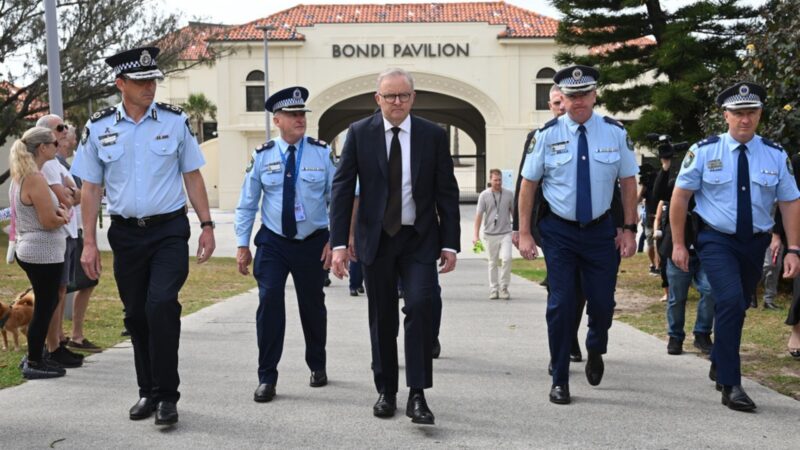
Australian Prime Minister Anthony Albanese has announced plans to toughen the country’s gun laws following a mass shooting at a Hanukkah celebration on Sydney’s Bondi Beach that killed at least 15 people and injured dozens more.
The attack happened on Sunday evening during a family event known as Chanukah by the Sea. Police say a father and son opened fire on the crowd, triggering one of Australia’s deadliest shootings in nearly 30 years.
At least 38 people remain in the hospital. Those killed include a 10-year-old girl, a rabbi and a Holocaust survivor.
Gun licences under review after Bondi Beach shooting
Speaking to reporters on Monday, Albanese said his government would push for stricter national gun rules, including limits on how many firearms a licensed owner can possess.
Authorities revealed that the older gunman, a 50-year-old man who was shot dead by police, had held a gun licence for about 10 years and had legally acquired six firearms. He was also a member of a gun club.
“People’s circumstances can change. People can be radicalised over time,” Albanese said. “Licences should not be in perpetuity.”
He described the shooting as an act of antisemitic terrorism and said it struck “at the heart of the nation”.
The prime minister said his proposals would be presented to a national cabinet meeting involving state and territory leaders. Some changes would require state-level legislation.
“We want to make sure we are all completely on the same page,” he said.
New South Wales Premier Christopher Minns backed the move, saying gun licences should not be granted indefinitely.
He confirmed state gun laws would change, though details are still being worked out.
“If you’re not a farmer or involved in agriculture, why do you need these massive weapons that put the public in danger?” Minns said.
Australia’s gun laws were last significantly tightened after the 1996 Port Arthur massacre in Tasmania, where 35 people were killed.
Questions raised over antisemitism and security failures
The attack has also sparked anger and fear within Australia’s Jewish community, with leaders questioning whether authorities did enough to prevent the violence amid a rise in antisemitic incidents.
“There’s been a heap of inaction,” said Lawrence Stand, a Sydney resident who rushed to Bondi after learning his 12-year-old daughter was at a nearby Bar Mitzvah event.
Alex Ryvchin, a spokesperson for the Australian Council of Executive Jewry, said the government had failed in its most basic duty.
“When an attack like this takes place, the fundamental responsibility of government is to protect its citizens,” he said. “There’s been an immense failure.”
He called for a full investigation into how the attack was allowed to happen. Police and security agencies said inquiries were already underway.
What is known about the attackers
Police have confirmed the shooters were a father and son, but have not released their names.
New South Wales Police Commissioner Mal Lanyon said the father held a licence that allowed him to own rifles or shotguns for approved reasons such as target shooting, hunting or vermin control. Self-defence is not a valid reason under Australian law.
The man arrived in Australia in 1998 on a student visa and later became a resident. Authorities have not disclosed his country of origin.
His 24-year-old son, who was born in Australia, was shot and wounded and remains in the hospital. Police say he may face criminal charges once the investigations are complete.
Albanese confirmed that Australia’s domestic intelligence agency, ASIO, had looked into the son for six months in 2019. He said the investigation focused on people the man was associated with, not on him directly, and concluded there was no ongoing threat at the time.
Australian media reported that ASIO examined possible links to an Islamic State–related cell in Sydney, though officials have not publicly detailed those connections.
Victims mourned as tributes grow at Bondi
Authorities have not formally released the names of the victims, but details began emerging on Monday. The dead ranged in age from 10 to 87.
Rabbi Eli Schlanger, an assistant rabbi at Chabad of Bondi and one of the organisers of the Hanukkah event, was among those killed, according to Chabad.
Israel’s Foreign Ministry confirmed the death of an Israeli citizen. French President Emmanuel Macron said a French national, Dan Elkayam, was also among the victims.
Larisa Kleytman said her husband, Alexander Kleytman, died in the attack. Both were Holocaust survivors, according to Australian media.
Hundreds of people gathered near Bondi Beach on Monday to lay flowers and pay their respects. Many also praised a bystander who was filmed tackling and disarming one of the gunmen.
The man was identified by Home Affairs Minister Tony Burke as Ahmed al Ahmed, a 42-year-old fruit shop owner and father of two. He was shot in the shoulder by the second attacker and survived.
Rising antisemitism in Australia
Australia, home to around 117,000 Jewish people, has seen a sharp rise in antisemitic attacks over the past year, particularly in Sydney and Melbourne. Synagogues, homes and businesses have been targeted, and individuals assaulted.
Since the Hamas attacks on Israel on 7 October 2023 and the subsequent war in Gaza, the Australian government has introduced measures to combat antisemitism. These include appointing a special envoy, strengthening laws and increasing security funding for Jewish schools and synagogues.
Israeli Prime Minister Benjamin Netanyahu said he had warned Australian leaders months ago about the risks of failing to act against antisemitism. He criticised Australia’s decision to recognise a Palestinian state, claiming it fuelled hostility. Albanese has rejected that claim.
On Monday, the prime minister called for unity.
“There is no place in Australia for antisemitism,” he said, pledging solidarity with the Jewish community.
Albanese added that while he previously blamed Iran for two earlier antisemitic attacks and cut diplomatic ties with Tehran, there is no suggestion Iran was linked to Sunday’s shooting.