
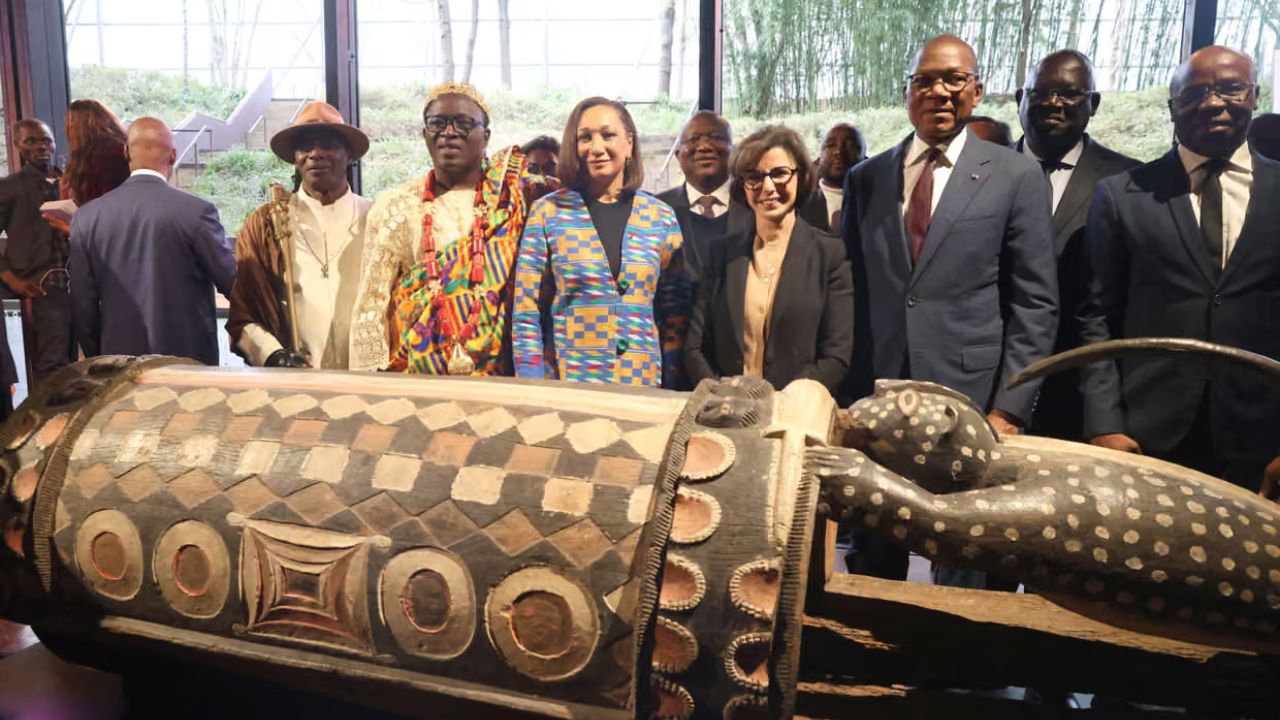
For over 100 years, the Djidji Ayokwe existed only in memory and museum records for most Ivorians.
However, on Friday, August 7, that changed. The sacred wooden drum, looted by French colonial troops in 1916, was unveiled to the public for the very first time since its return in February this year.
The ceremony fell on Ivory Coast’s independence day, adding extra weight to the moment. The drum, a “talking drum” once used by the Ebrie people to send messages across long distances, is more than three meters (10 feet) long and weighs 430 kilograms (950 pounds).
Seen, but not yet believed
Even after France officially handed the drum back in February and it arrived in Ivory Coast in March, it stayed sealed inside a wooden crate, unseen by the public for months.
Friday’s ceremony was the moment that finally changed.
For 69-year-old villager Jacqueline Akrebie, that visual proof mattered more than any paperwork. “We want to see the drum with our own eyes so we can truly believe it belongs to us,” she told AFP.
A homecoming procession
The drum was carried through Abidjan’s Yopougon district in a military parade before continuing to Adjame, the village where it was originally made.
It travelled in a glass-fronted case atop a decorated float, greeted by Culture Minister Francoise Remarck, traditional leaders, and hundreds of residents.
A libation ceremony followed, with participants pouring liquid onto the ground as an offering to their ancestors.
“A nation cannot develop if it doesn’t preserve its memory and promote its heritage,” said Adjame mayor Farikou Soumahoro, describing the moment as one of “deep emotion and great pride.”
Traditional leader Cyriaque Ahoure, 63, called it a moment of “great joy, when we remember our ancestors.”
More than an instrument
The Djidji Ayokwe was never just a musical object. The Ebrie community used it to warn of danger, including from colonial forces, as well as to call people to war or summon villagers for ceremonies.
French colonial authorities seized the drum in 1916, shipped it to Europe in 1929, and displayed it in Paris for decades.
Ivory Coast requested its return in late 2018, as part of a broader claim covering 148 artworks and artefacts taken during the colonial era, one of hundreds of items France is now preparing to return, a process accelerated by a new French law approved in May.
The drum is set to go on permanent display at the newly renovated Museum of Civilisations in Abidjan.
A wider reckoning
Ivory Coast isn’t alone in seeking the return of its cultural heritage; Senegal and Benin have made similar requests.
Across Europe and the United States, museums, institutions and private collectors are facing growing pressure to return artefacts taken from former colonies, making restitution one of the most closely watched cultural and political issues linking Africa and the West today.