
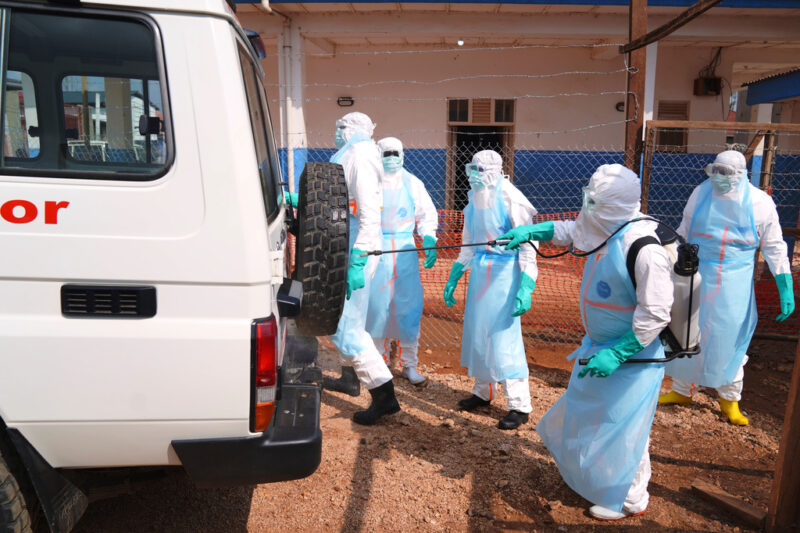
More than 1,000 people have now died in the Ebola outbreak sweeping the Democratic Republic of Congo. Africa’s top health body says it is spreading faster than any Ebola outbreak on record.
Dr. Jean Kaseya, head of the Africa Centres for Disease Control and Prevention, gave the update at a health summit in Ghana on Wednesday. He confirmed 1,031 deaths so far.
Kaseya said the deaths are avoidable. He blamed the toll on a lack of vaccines, medicine, and funding.
Congo’s health ministry says 2,473 cases have been recorded since the outbreak began. Over 700 patients are currently hospitalized or in isolation.
Why this outbreak is so dangerous
The outbreak was declared on May 15. It’s caused by the Bundibugyo strain of Ebola, a version of the virus with no approved vaccine or treatment.
It’s also moving faster than any past outbreak. By comparison, the devastating 2013-2016 West African epidemic, which killed over 11,000 people, took about eight months to reach its first 1,000 deaths. This one got there much quicker.
Health officials also believe the real number of cases is far higher than what’s been reported, possibly two to four times more, according to the World Health Organization. Fighting between armed groups is making it hard for responders to reach some communities at the heart of the outbreak.
Fighting and mistrust are slowing the response
Ebola spreads through contact with bodily fluids like blood, vomit, or semen. It’s rare but extremely dangerous, and often fatal.
Right now, 80% of new cases can’t be traced back to a known source. That means health workers are struggling to keep up with how fast the virus is moving, even as they scale up efforts in Ituri province, the center of the outbreak, and four other affected provinces.
Many communities are also refusing help. Ebola teams carrying out safe burials have faced resistance, since some families prefer traditional funeral practices. Robert Ndjalonga, a civil protection official in Ituri, said burial teams have sometimes needed police escorts just to do their jobs safely.
Supply shortages are adding to the problem, some areas don’t even have a burial team in place yet, Ndjalonga said.
Health workers themselves are under threat. Some clinics and response teams have been attacked, forcing aid groups to pull out of certain areas. Others have gone on strike over unpaid wages. Last week, a burial team member was hurt when their vehicle was stoned by attackers in Bunia.
In one telling sign of how seriously the threat is being taken, a local military official in Ituri’s Irumu territory said Ebola is now more dangerous than the Islamic State-linked rebels operating in the region, and urged people to protect health workers rather than attack them.
The response is struggling to keep pace
A humanitarian worker involved in the response, who asked not to be named, described a chaotic picture: poor coordination between agencies, delays moving patients to treatment centers, and test results taking more than four days to come back.
That’s pushing some sick patients to leave health facilities before they’re even diagnosed, making it more likely they’ll spread the virus further.
Kaseya has urged a faster, stronger response. He warned that without immediate action, this could become one of the worst Ebola outbreaks ever recorded.
The numbers back up his concern. Fewer than 9% of the people who came into contact with confirmed patients are currently being monitored, far short of what’s needed to control the outbreak. More than 60% of deaths are happening in the community, before people even reach a hospital.
Pierre Akilimali, who’s managing the outbreak response for Congo’s National Public Health Institute, says that points to a troubling pattern: many infections simply aren’t being caught in time.
Experts fear it could get worse
Last month, U.S. CDC researchers modeled how the outbreak might unfold. In their worst-case scenario, it could grow to rival the massive 2014-2016 West African epidemic.
Trish Newport of Doctors Without Borders, who has worked on the ground in Congo, said no past Ebola outbreak has started with this many cases undetected for so long. She described it simply: the outbreak is outrunning the response.
Not everyone expects the worst-case scenario to play out. Dr. Jean Nachega, an epidemiologist at the University of Pittsburgh advising African health authorities, doesn’t think it will reach that scale, but he agrees the challenges ahead are enormous.