
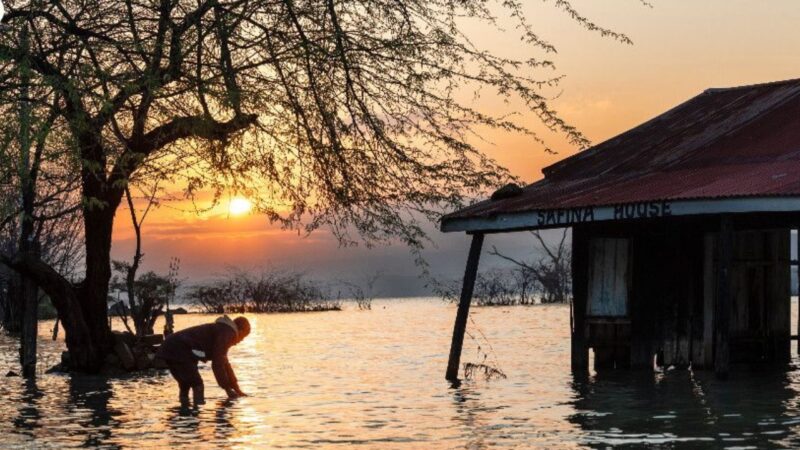
A crocodile resting on the roof of a submerged conference hall has become a powerful symbol of a growing climate crisis in Kenya’s Rift Valley.
The unusual scene was captured at a once-popular holiday resort on the shores of Lake Baringo, where rising water levels have swallowed buildings, displaced families and put local businesses at risk.
Scientists say Lake Baringo and other lakes in the region have reached their highest levels in more than 50 years, driven largely by extreme rainfall patterns linked to climate change.
Thousands of residents have been forced to move to higher ground, but many say the rising waters continue to follow them.
Climate change brings new dangers
For Mary Milka Tiren, the lake’s expansion has brought years of tragedy.
In 2011, during the first major rise in Lake Baringo’s water levels, she lost her husband after he was attacked by a hippo while returning home from work at a tourist resort that is now completely underwater.
More than a decade later, her nine-year-old son survived a crocodile attack that left a deep scar on his arm.
“The crocodile wanted to tear off his entire arm from the shoulder, but his friends managed to rescue him after a long struggle,” Tiren said.
Wildlife officials say the increase in attacks is not because crocodile and hippo populations have suddenly grown, but because rising waters have pushed animals closer to human settlements.
“Crocodile attacks have increased because the lake is now much closer to people’s homes,” said Jackson Komen, a senior warden at the Kenya Wildlife Service.
He added that expanding lakes have destroyed natural grazing areas, increasing encounters between humans and hippos.
Lakes expanding at an alarming rate
Satellite analysis from Copernicus Sentinel and NASA Landsat imagery shows that Lake Baringo has expanded by about 70 percent since 2010.
The lake’s surface area has grown from around 138 square kilometres to more than 234 square kilometres.
Neighbouring Lake Bogoria, a saltwater lake famous for its flamingos and hot springs, has also expanded by about 21 percent during the same period.
The two lakes are now moving closer together, raising fears of major environmental changes.
Komen warned that if the freshwater Lake Baringo and the alkaline Lake Bogoria eventually merge, it could threaten fish, crocodiles and hippos that depend on very different ecosystems.
“If the two lakes mix, we could face an ecological disaster that we do not know how to manage,” he said.
Lake Baringo plays a crucial role in the region, providing water for households and farming while supporting thousands of people through fishing.
Tourism industry suffers major losses
The rising waters have also damaged Kenya’s tourism sector.
Wildlife conservancies around Lake Baringo have lost large areas of land, forcing animals including giraffes, ostriches, warthogs and impalas to be relocated.
At least four holiday resorts around the lake have been submerged, while another now sits abandoned on what has become an island.
Lake Bogoria, once a major attraction for visitors hoping to see thousands of flamingos and natural hot springs, has also been affected.
Many flamingos have disappeared, while some hot springs have been covered by rising waters.
Local disaster officials estimate tourism revenue has dropped from around $1 million a year to about $200,000.
Visitors have also reported fewer flamingos and damaged roads, making access to the area increasingly difficult.
Schools and families trapped by rising waters
The flooding has disrupted education in nearby communities.
Around 12 schools in the Lake Baringo and Lake Bogoria areas have been affected, with some completely submerged.
At Kokwa Island Primary and Junior School in Marigat, students and teachers now depend on a ferry to cross crocodile-filled waters.
The daily boat trips have reduced learning time, while the school’s girls’ dormitory faces the greatest danger as waves continue to reach its walls.
“It is risky for the girls because hippos and crocodiles enter the school area at night,” a school official said.
The school has hired additional security officers to protect students and fears further damage from expected heavy rains.
Families forced to abandon their homes
Many residents say they have run out of options.
Faith Mpayei, a mother of five, has moved the fence around her two-acre farm twice since 2016 as the lake continued to advance.
Today, the fence is underwater and rising water has reached part of her home.
“The lake has reduced me to nothing,” she said.
“We are helpless. I am only staying here temporarily. I have to relocate because there is nothing left.”
As climate change intensifies extreme weather events across East Africa, communities around Kenya’s Rift Valley lakes face an uncertain future, caught between rising waters, disappearing livelihoods and the challenge of finding new places to call home.